
Statutory Holiday Pay in Canada by Province (2026)
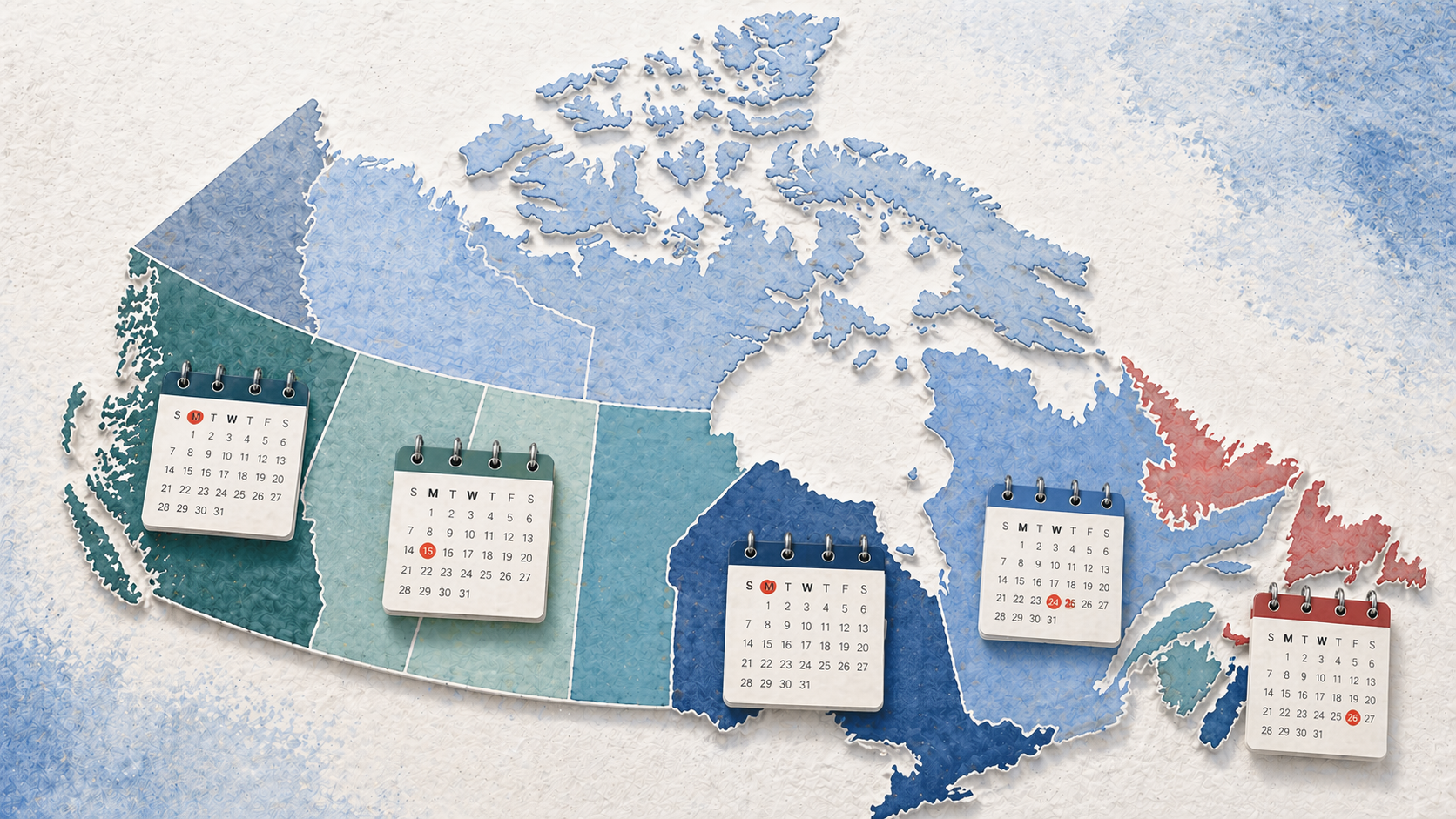
Statutory holiday pay in Canada is calculated as a proportion of an employee's recent earnings, typically 1/20 of wages earned in the four weeks before the holiday (federal, Ontario, Quebec) or 5% of a four-week earnings total (Manitoba, Saskatchewan). Canada has 13 provincial and territorial jurisdictions plus the federal sector, and every one defines eligibility, paid holidays, and calculation methods differently.
- Most provinces use a formula averaging recent earnings, not simply paying a regular day's wages
- Paid statutory holidays in 2026 range from 6 in Nova Scotia and Newfoundland to 10 in Saskatchewan, BC, the federal sector, and the three territories
- Employees who work a statutory holiday are generally entitled to premium pay of 1.5x their regular rate, though Quebec, Newfoundland, and PEI handle it differently
What statutory holiday pay is in Canada (2026)
Statutory holiday pay in Canada is the legally required wage an eligible employee receives for a designated public holiday, whether they work that day or not. It is a floor set by provincial or federal employment standards legislation. Most provinces use one of two calculation structures: the 1/20 method, which divides wages earned in a recent four-week reference period by 20, or the 5% method, which pays 5% of wages earned during the four weeks before the holiday.
Statutory holidays are sometimes called "stat holidays," "general holidays" (Alberta, Manitoba, federal sector), "public holidays" (Ontario, Saskatchewan), or "paid holidays" (Nova Scotia, Newfoundland). The naming does not change the legal obligation.
Statutory holidays by province: Canada (2026)
The number of paid statutory holidays in Canada in 2026 ranges from 6 in Nova Scotia and Newfoundland and Labrador to 10 in the federally regulated sector, British Columbia, Saskatchewan, Yukon, Northwest Territories, and Nunavut. The master comparison table below lists the paid holidays recognised in each jurisdiction for 2026.
| Jurisdiction | Holidays | Formula | Premium |
|---|---|---|---|
| Federal | 10 | 1/20 of 4-week wages | 1.5x + holiday pay |
| Alberta | 9 | Avg daily wage (4wk/days worked) | 1.5x + avg daily wage |
| British Columbia | 10 | Avg day's pay (30-day) | 1.5x first 12hrs, 2x after |
| Manitoba | 9 | 5% of 4-week wages | 1.5x + holiday pay |
| New Brunswick | 7 | Avg daily earnings (30-day) | 1.5x + regular day's pay |
| Newfoundland and Labrador | 6 | Avg day's pay (3-week) | 2x regular rate |
| Nova Scotia | 6 | Regular day's pay or avg | 1.5x + regular day's pay |
| Ontario | 9 | (Wages+vacation pay)/20 | 1.5x + holiday pay or 1x + sub day |
| Prince Edward Island | 7 | Regular rate or avg daily | 1.5x + holiday pay |
| Quebec | 8 | 1/20 of 4-week wages | Regular wage + indemnity (no 1.5x) |
| Saskatchewan | 10 | 5% of 4-week wages | 1.5x + holiday pay |
| Yukon | 10 | Regular day's pay or avg | 1.5x + regular day's pay |
| Northwest Territories | 10 | Avg day's pay (4-week) | 1.5x + holiday pay |
| Nunavut | 10 | Avg day's pay (4-week) | 1.5x + holiday pay |
How statutory holiday pay is calculated in Canada
Statutory holiday pay in Canada is calculated using one of three formula types: a 1/20 formula, a 5% formula, or an average-daily-earnings formula. The 1/20 formula (federal, Ontario, Quebec) takes total wages earned in the four work weeks before the holiday and divides by 20. The 5% formula (Manitoba, Saskatchewan) multiplies total wages earned in the four weeks before the holiday by 5%. The average-daily-earnings formulas (BC, Alberta, New Brunswick, PEI) divide total wages by days actually worked in a defined lookback period.
Three rules apply almost everywhere: overtime is excluded from the earnings used in the calculation; vacation pay is included in Ontario and Quebec but excluded elsewhere; employees who work the stat holiday receive premium pay (usually 1.5x) on top of holiday pay.
Federal statutory holiday pay rules (Canada Labour Code)
Federally regulated employees are entitled to 10 paid general holidays per year under the Canada Labour Code, calculated as 1/20 of wages earned (excluding overtime) in the four-week period before the holiday. Eligibility is straightforward: any employee of a federally regulated employer qualifies, with no minimum length of service required.
Statutory holiday pay in Alberta
Alberta employees are entitled to 9 general holidays under the Employment Standards Code, with pay calculated as the average daily wage: total wages divided by days worked in the 4 weeks before the holiday. To qualify, an employee must have worked at least 30 workdays in the 12 months before the holiday. An employee who works receives 1.5x their regular wage plus their average daily wage.
Example: a server who worked 15 days over the 4 weeks before Canada Day earning $3,000 total has an average daily wage of $200.00. If she works 8 hours on Canada Day at $18.00 per hour, she receives $216.00 (1.5x for hours worked) plus $200.00 average daily wage, totalling $416.00.
Statutory holiday pay in British Columbia
British Columbia employees are entitled to 10 statutory holidays under the Employment Standards Act, with pay calculated as an average day's pay based on wages earned in the 30 calendar days before the holiday. To qualify, an employee must have worked or earned wages on at least 15 of the 30 days immediately before the holiday, one of the strictest eligibility tests in Canada.
An employee who works on a BC statutory holiday receives 1.5x their regular wage for the first 12 hours and 2x for any hours beyond 12, in addition to an average day's pay.
Statutory holiday pay in New Brunswick
New Brunswick employees are entitled to 7 prescribed public holidays under the Employment Standards Act, with pay calculated as average daily earnings for days worked in the 30 calendar days before the holiday. Eligibility requires the employee to have worked with the employer for at least 90 calendar days within the 12 months before the holiday. An employee who works receives 1.5x their regular rate plus one regular day's pay.
Statutory holiday pay in Newfoundland and Labrador
Newfoundland and Labrador employees are entitled to 6 paid holidays under the Labour Standards Act, with pay calculated as an average day's pay based on wages earned in the 3 weeks before the holiday. An employee who works on a paid holiday receives 2x their regular rate, one of the highest premium rates in Canada.
Example: a St. John's server earning $16.00 per hour who works 7 hours on July 1 receives $224.00 (2x rate), meaningfully higher than the same shift in Ontario or Alberta.
Statutory holiday pay in Ontario
Ontario employees are entitled to 9 public holidays under the Employment Standards Act, 2000, with pay calculated as regular wages plus vacation pay in the 4 work weeks before the holiday, divided by 20. Ontario is unusual because vacation pay is included in the earnings figure, unlike most other provinces. All Ontario employees qualify regardless of length of service.
Example: a server who earned $2,400 in regular wages plus $96.00 in accrued vacation pay (4%) during the 4 weeks before Canada Day would receive $124.80 in public holiday pay (($2,400 + $96) divided by 20), not $120.00.
Statutory holiday pay in Prince Edward Island
Prince Edward Island employees are entitled to 7 paid holidays under the Employment Standards Act, with pay calculated as the employee's regular rate for regular hours, or average daily earnings from the 30 days before the holiday for irregular-hours staff. To qualify, an employee must have earned wages on at least 15 of the 30 calendar days before the holiday.
Statutory holiday pay in Saskatchewan and Quebec
Saskatchewan employees are entitled to 10 public holidays under the Saskatchewan Employment Act, with pay calculated at 5% of wages earned in the 4 weeks before the holiday. There is no minimum length of service required; all employees qualify from their first day.
Statutory holiday pay in Quebec
Quebec employees are entitled to 8 statutory holidays under the Act respecting labour standards, with a holiday indemnity calculated as 1/20 of wages earned in the 4 complete weeks before the holiday. Quebec does not apply a 1.5x premium rate for working a statutory holiday, the most significant structural difference from the rest of Canada.
Statutory holiday pay in the territories and worked example
Yukon, Northwest Territories, and Nunavut employees are each entitled to 10 statutory holidays under their respective Employment Standards Acts, with calculation methods that broadly follow the federal 1/20 approach. In Yukon, pay is calculated as a regular day's pay or total wages divided by days worked in the 4 weeks before the holiday. NWT and Nunavut use an average day's pay based on wages earned in the 4 weeks before the holiday.
Worked example: calculating statutory holiday pay for Canada Day 2026
Consider a part-time barista who earned $1,800 in regular wages over the 4 weeks before Canada Day 2026, worked 15 days, and accrued $72.00 in vacation pay.
Ontario: $1,800 + $72 = $1,872 divided by 20 = $93.60. Federal/Quebec: $1,800 divided by 20 = $90.00. Saskatchewan/Manitoba: $1,800 times 5% = $90.00. Alberta/BC: $1,800 divided by 15 days = $120.00.
The spread between the lowest ($90.00) and highest ($120.00) is 33% for this worker, before layering in premium pay if the barista actually works the shift.
Common statutory holiday pay mistakes Canadian employers make in 2026
The most common statutory holiday pay errors for Canadian operators in 2026 are using a flat day's pay instead of the province's required formula, excluding eligible part-time workers, forgetting to layer premium pay on top of holiday pay, and applying Ontario's vacation-pay-inclusive formula in other provinces.
- Paying salaried employees nothing extra for stat holidays when the statutory formula would produce a separate entitlement
- Assuming employees in their first 30 days do not qualify, which is incorrect in Ontario, Saskatchewan, Quebec, and the federal sector
- Treating Remembrance Day as paid in provinces where it is not (Ontario, Quebec, Nova Scotia, Manitoba)
- Missing National Day for Truth and Reconciliation for federally regulated, BC, PEI, Manitoba, Yukon, NWT, and Nunavut workers
- Calculating holiday pay based on base hourly rate instead of total earnings, which under-pays tipped servers
Frequently asked questions about statutory holiday pay in Canada
Statutory holiday pay in Canada is calculated using one of three formulas: 1/20 of wages earned in the four weeks before the holiday (federal, Ontario, Quebec), 5% of wages earned in the four weeks before the holiday (Manitoba, Saskatchewan), or average daily earnings based on a 30-day or 4-week lookback (BC, Alberta, New Brunswick, PEI). Overtime is excluded. Vacation pay is included only in Ontario.
Most Canadian employees qualify provided they meet the provincial eligibility test. Ontario, Saskatchewan, Quebec, and the federally regulated sector have no minimum length of service. BC requires 15 of 30 days worked before the holiday. Alberta requires 30 workdays in the previous 12 months.
Yes, part-time employees are entitled to statutory holiday pay in every Canadian province and territory as long as they meet provincial eligibility. The formulas are designed to produce a fair day's pay based on recent earnings rather than a full-time salary.
The holidays recognised in most Canadian provinces in 2026 are New Year's Day, Family Day or provincial equivalent, Good Friday, Victoria Day, Canada Day, Labour Day, Thanksgiving, and Christmas Day. Remembrance Day, National Day for Truth and Reconciliation, and Boxing Day are paid holidays only in certain provinces.
Yes, Victoria Day (May 18, 2026) is a paid statutory holiday in most Canadian provinces and territories, including Ontario, Alberta, British Columbia, Manitoba, Saskatchewan, New Brunswick, PEI, and the three territories. It is also paid for federally regulated employees. Nova Scotia and Newfoundland and Labrador do not recognise it.
Yes, Victoria Day is one of Ontario's 9 public holidays under the Employment Standards Act, 2000. Eligible employees are entitled to public holiday pay calculated as regular wages plus vacation pay earned in the four work weeks before the holiday, divided by 20.
Yes, in most Canadian provinces employees who work on Victoria Day receive time and a half (1.5x their regular rate) for hours worked, in addition to their statutory holiday pay for the day. Newfoundland and Labrador pays 2x for hours worked on a paid holiday.
Yes, Victoria Day is a paid general holiday in Manitoba under the Employment Standards Code. General holiday pay in Manitoba is calculated at 5% of total wages earned in the four weeks before the holiday. Employees who work receive 1.5x their regular rate plus the 5% general holiday pay.
Nova Scotia recognises 6 paid holidays under the Labour Standards Code in 2026: New Year's Day, Heritage Day, Good Friday, Canada Day, Labour Day, and Christmas Day. Victoria Day, Thanksgiving, Remembrance Day, and Boxing Day are not paid statutory holidays for most private-sector employees.
Jana Reserva
Ready to get started with Tanda?




Keep compliance top of mind with workplace resources
Get the latest tools and articles sent straight to your inbox